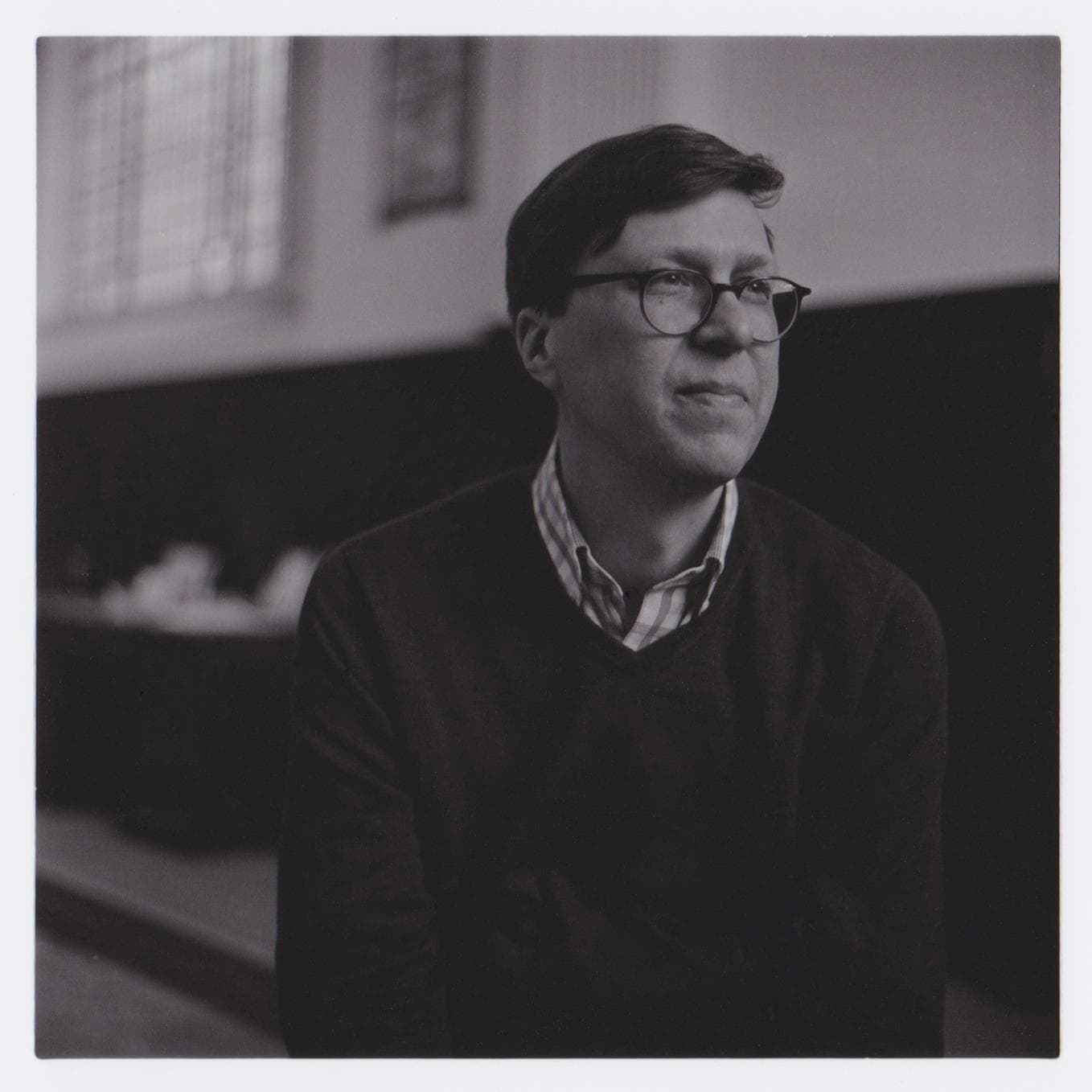
Magnus Granberg - Magnus Granberg & SkogenThe Willow Bends and So Do I
Magnus Granberg & Skogen

Released by Another Timbre on August 22nd, 2025. Recorded by Calle Gustavsson at Atlantis, Stockholm, June 2024. Mixed and mastered by Anders Dahl.
Skogen:
Anna Lindal, violin
Eva Lindal, violin
Leo Svensson Sander, cello
Finn Loxbo, acoustic steel string guitar
Stina Hellberg Agback, harp
Magnus Granberg, prepared piano & composition
Erik Carlsson, percussion
Henrik Olsson, objects, contact microphones, thumb piano
Petter Wästberg, contact microphone, mixing board, loudspeaker
Interview with Simon Reynell:
Can you tell us about this composition? What does the title refer to? And from what pieces of music have you derived material for the piece?
The piece was written in spring 2024 and basically consists of four large pools of materials as well as a temporal framework in which the four different pools are ordered into a total of ten cycles, the duration of each cycle being approximately six minutes. Each pool consists of individual sounds, a number of short phrases (each containing two to seven different sounds) as well as an eighteen bar melody in slightly shifting meters from which the performers can choose what and when to play in accordance with a set of guidelines which accompany the individual parts.
The phrases are derived from a small series of tiny rhythmic modules in very simple note values as well as their augmentations and diminutions, whereas the tonal materials all are derived from a few bars from a song by American jazz and film music composer Johnny Mandel called ’A Time for Love’, from which the piece also borrows its title. I first heard the song in my mid teens on ’Alone’, a solo piano album by jazz pianist Bill Evans which was recorded and released in the late 1960s, and which must have been one of the very first CDs that I bought in the very late eighties. There are actually quite a lot more raw materials which I wrote at the time but which I didn’t use for this piece but rather intended to be employed in what eventually might become a small family of pieces for various kinds of settings and ensembles. A first (or perhaps rather second) realisation taking this larger pool of materials as its point of departure is a piece which I wrote for the lovely American string duo andPlay, which was premiered and toured earlier this summer along with a new piece for Angharad Davies.
The ensemble on the new CD is relatively large (9 players). Was there a reason for that, and does it change anything in the way you compose when the performing group is larger?
Well, I think the main reason for writing for this comparatively large ensemble was quite simply that I wanted to gather all the Swedish friends and members of the ensemble, including those players who started to play with Skogen during the pandemic (or perhaps rather during those periods during the pandemic when it was possible meeting up a few people doing something at least) with the addition of guitarist Finn Loxbo whom we and I also had worked with on a couple of different occasions lately. But it’s of course also a question of really enjoying writing for and playing with a relatively large ensemble of this kind, of being part of a musical environment consisting of so many different voices, movements, timbres and temperaments and the particular sense of fulfilment which it brings. As for the question whether anything changes when I write for somewhat larger ensembles, that quite often depends on the schooling and experiences of the members of the ensemble. In this particular instance, where the musicians all have plenty of experience improvising and playing open scores, my writing doesn’t differ very much when writing for a smaller or somewhat larger ensemble, but if I were to write for other kinds of ensembles where the different members had less experience with these ways of working, I would probably limit the amount of materials and choices to a certain extent. And in some cases I also write pieces which are more or less fixed, for example the piece I recently wrote for andPlay, which is a violin & viola duo. I guess it’s sometimes quite simply a matter of what is practical doing when working with particular musicians but of course also a matter of exploring and examining various kinds of musical dynamics.
This particular version of Skogen is all Swedish, and includes two or three players who are relatively new to the ensemble, alongside several Skogen regulars. Is there now a pool of local musicians keen to play with Skogen?
There is a handful of relative newcomers on this recording, though a couple of them like violinist Eva Lindal (who also happens to be the sister of longtime Skogen member Anna Lindal) and harpist Stina Hellberg Agback have been playing with us since the pandemic, - so were both on ’How Lonely Sits the City?’ which was recorded in 2021 and released on Another Timbre the following year. Eva and Stina are both such great and versatile musicians with experiences from so many different fields of music, including early and new music as well as improvised and experimental musics of various kinds. As for guitarist Finn Loxbo we had first worked together on a double album (’Night Will Fade and Fall Apart’) which was released on the Swedish record label Thanatosis in 2022, and Finn also joined Skogen for the music which I wrote for director Karl Dunér’s production of The Persians and The Women of Troy, which was staged at the Royal Dramatic Theater in Stockholm in 2023. Finn is a wonderful and very exciting musician (for example with his brilliant ensemble Kommun) whose playing I have admired for a number of years, so I’m very happy to have him with us.
As for the question whether there is a pool of Swedish musicians keen to play with Skogen I must say that I don’t really know! But I do know that there are quite a few brilliant young players here in Stockholm that I myself really would like to work with more at some point, people like violinist Maya Bennardo, kecapi player and composer Kristofer Svensson, percussionist Ryan Packard and double bassist Vilhelm Bromander, just to name a few. I’m very happy for and curious and excited about all the new musicians and composers that are becoming part of the scene, and I really hope to find ways of collaborating with as many of them as possible at some point, in one form or the other.
The Willow Bends And So Do I is an hour-long piece from Stockholm-based Magnus Granberg, whose output sits somewhere between modern chamber music & gentle improvisation. This 2024 work is played by Skogen- a nine-piece collective, which features the composer him self on prepared piano. And as a long-term fan of Mr Granberg's output, I’m happy to report this is another wholly captivating piece which seesaws between haunting, angularly intriguing, and subtle yet rewardingly noisy- with generally enchantingly creative use of textural detail throughout. The album appears on the always worthy Another Timbre, whom releases the best/ most interesting within the modern composition/ modern classical genres. The CD comes presented in the label's house style/ sparse mini gatefold packaging, featuring an old Asian illustration of two people walking across a snow-covered bridge with paper umbrellas up; just to the side of them is a willow tree. Playing the piece we have: Magnus Granberg- prepared piano. Anna Lindal- Volin. Eva Lindal- Volin. Leo Svensson Sander- cello. Finn Loxbo- acoustic steel string guitar. Stina Hellberg -Agback harp. Erik Carlsson- percussion. Henrik Olsson- objects, contact microphones, thumb piano. Petter Wästberg- contact microphone, mixing board, loudspeaker. The single track here runs at one hour and forty-three seconds, and it remains truly compelling throughout, and the more you play it, new details/ elements surface. The piece is built around a stark base of gently darting/ moving piano tones, slowly sweeping/ sparse string sweeps, and just about moving/stumbling percussion detail. Around this base, the nine-piece adds all manner of intriguing or atmospheric sonic detail. Moving between the non-musical/ musical – going from the distant hum of radio chatter( suggesting hazy, half-lit seances). to slurred/ slowly shuffling jazz percussion (suggesting early hours/ barely moving shady nightclub performances). There is a strange boing sound- which moves between shadowy/ shifting and very pronounced/ quite agitated. A simmering yet mysterious fed back drone, and much more. All making for a slowly shifting sound soap- that is full of wonderful detail and sonic reward. The Willow Bends And So Do I, is another prime example of Mr Granberg’s highly distinctive sound/ sonic vision. There truly aren’t many composers who can shift through such a range of different sonic emotions/ moods in such a drowsy- yet wonderfully nuanced manner. Totally spellbinding stuff.
Roger Batty, Musique Machine
The two most recent Granberg releases on Another Timbre give you both the truth and the lie behind the observation of “always different; always the same”. When Holde Träume, Kehret Wieder! came out last year I lost track of it in the shuffle of events at the time, then was spurred to recover it when The Willow Bends And So Do I cam out. Can I tell them apart? At least as well as I know my Bach(s). Would it matter? No. I needed a better context, so I listened to these in succession variously with some of his older works, such as 2012’s Despairs Had Governed Me Too Long and 2013’s Would Fall from the Sky, Would Wither and Die. Granberg’s compositions typically play out over 45 to 60 minutes, so they don’t lend themselves readily to comparison testing. From this perspective, Despairs sounds more withdrawn and furtive than before, Fall testing how far it can act out without risking the overall form. Over the years, Granberg and the core group of musicians he has worked with have developed a clarity of purpose in playing these works, still highly sensitive to the delicate environment each piece creates, while being confident enough to speak out when needed. Holde Träume, Kehret Wieder! was composed in 2021 and is presented here in two versions, a septet performed by Skogen and a version played by the quartet Nattens Inbrott. Both were recorded in the same studio in Stockholm in November that year; both ensembles include Granberg himself and percussionist Erik Carlsson. Granberg’s signature prepared piano, common to almost all the recordings of his music I’ve heard so far, plays a slow and fairly steady succession of isolated sounds which act as vertebrae around which each piece is built. He draws upon other music for his material, ranging from old pop songs to Schubert, but any direct reference is sublimated through slowness and by pooling resources between the musicians who often play on the threshold between pitch and non-pitch. Sounds are shared and exchanged through a loose but organised dialogue (I’m still think about Guðmundur Steinn Gunnarsson here). I’m going to venture that the flavour of each piece comes from the rarefied sentimentality captured in the source material, even as its appearance has been transcended. Holde Träume focuses on stillness and texture, falling into sections defined by the amount of surface activity. The quartet version is all acoustic; the septet adds the electroacoustic elements of amplified objects, friction. The septet take is still transparent, not much less empty, but with an expanded range of low sounds and faint noise. The Willow Bends And So Do I was composed in 2024, with Skogen appearing here as a nonet with some new members. Melody, in its own strange way, is present throughout and the piece progresses through its sixty minutes in a continous form, with changes across the piece made by periodic alterations to melodic patterns and shifting roles for timbre with each instrument. Musicians exchange foreground and background roles, producing an intricate counterpoint. The dynamics are gentle but firm throughout, without any semblance of reticence. It captures the experience I recall of hearing them play live. Speaking of which, I may even leave the house to hear Skogen again this weekend, a 13-piece band playing Granberg’s 2023 piece Trouble, Had it All My Days.
Ben Harper, Boring Like a Drill
Ursprunget till detta timslånga stycke är den amerikanske kompositören Johnny Mandels stycke A time for love. Magnus Granberg hörde det som tonåring med pianisten Bill Evans och han använder tonmaterialet från några takter av låten, enligt en intervju på Another Timbres hemsida. Det är inget jag märker, och för upplevelsen är det inte viktigt, men det är bakgrunden. Kompositionen består av olika delar med ett antal möjligheter för musikerna att välja inom varje del, och ett antal riktlinjer för valen, frihet inom vissa ramar alltså. I detta letar sig även en melodi försiktigt fram. På ett övergripande plan verkar det inte hända så mycket, skillnaderna mellan de olika delarna ovan är inte tydliga. Allt ser ut att stå nästan stilla, men samtidigt händer det små saker hela tiden, små rörelser. Vi omsluts av ett klingande rum, försätts i ett slags tillstånd där olika detaljer kommer fram. En skog av ljud, glest och sprött, tyngre dropp, vid något tillfälle insisterande högljutt. Stora öron är riktade mot varandra inom spelgruppen. De försöker inte locka oss, men låter oss gärna vara med. Anna Lindal fiol, Leo Svensson Sander cello, Magnus Granberg preparerat piano, Erik Carlsson slagverk, Henrik Olsson objekt, kontaktmikrofoner och tumpiano och Petter Wästberg kontaktmikrofon, mixerbord och högtalare är de som varit längst i Skogen. Eva Lindal fiol, Finn Loxbo stålsträngad gitarr och Stina Hellberg Agback harpa är nytillkomna röster i sammanhanget. Tidigare inspelningar med Skogen täcker liknande, rikt fascinerande landskap som detta, vilka jag också gärna försjunker i, överraskad blir jag inte.
Magnus Granberg is a composer and performer working at an intersection between contemporary chamber music and improvisation. He is based in Stockholm, Sweden.
Born in Umeå in 1974, he studied saxophone and improvisation at the University of Gothenburg and in New York in his late teens and early twenties. Self-taught as a composer, he formed his own ensemble Skogen in 2005 trying to integrate experiences, methods and materials from various traditions of improvised and composed musics into a new modus operandi.
His music has been performed in Norway, Sweden, Switzerland, the United States, England, Austria, Hungary and Slovenia, broadcast by public radio channels in England (BBC Radio 3 and 6), Germany (SWR 2), Sweden (SR P2), Estonia, Slovenia, Serbia, Hungary and the United States, and has been published by the renowned British record label Another Timbre.
Skogen is a Swedish ensemble working at an intersection between contemporary chamber music and improvisation. The ensemble was founded in 2005 and has since its inception collaborated regularly with international artists such as Angharad Davies, Ko Ishikawa, Toshimaru Nakamura, Rhodri Davies and Simon Allen. The ensemble has mainly been performing music by its founder Magnus Granberg, but has also performed and recorded music by composers such as Anders Dahl and Morgan Evans-Weiler.
The music, which originates from the interplay between composition and improvisation and between individual and collective processes, is a poetical practice which in subtle and seemingly paradoxical ways unifies order with chaos, unity with diversity and the past with the present.
The ensemble has released seven CDs on the renowned British record label Another Timbre and has performed at festivals such as Ultima (NO), Huddersfield Contemporary Music Festival (UK), Himera (FI), Sound of Stockholm (SE), Splitter Music Festival (DE) and Ulrichsberger Kaleidophon (AT).
Personnel (various settings and sizes):
Eva Lindal (violin, Anna Lindal (violin) Angharad Davies (violin) Leo Svensson Sander (cello), Stina Hellberg Agback (harp), Rhodri Davies (harp), Magnus Granberg (prepared piano), John Eriksson (vibraphone and percussion) Simon Allen (vibraphone and percussion) Erik Carlsson (percussion), Henrik Olsson (percussion and electronics), Petter Wästberg (electronics and objects), Ko Ishikawa (sho), Toshimaru Nakamura (no-input mixing board) and Heather Roche (clarinet).